Psu Educational Leadership Continuing Administrator Program

The 11th annual International Initiative for Promoting Political Economy drew a group of professors and doctoral researchers from four continents to the University of Bologna, Italy, last month, the world's oldest university. Professor of Educational Leadership and Policy, Dr. Ramin Farahmandpur of Portland State University was among those invited to present on the topic of "Socio-Ecological Crisis and the Political Economy of Sustainability."
"We at the Department of Educational Leadership and Policy are incredibly fortunate to have the opportunity to work alongside Professor Farahmandpur. In a time when we, as a society, continue to seek out a more equitable and inclusive path forward, we are proud of Dr. Farahmandpur's continual work, which spearheads our collective effort on the international stage," says Dr. Moti Hara, chair of the department in the College of Education at PSU.
This was the third time that Dr. Farahmandpur has been selected to present at the international conference. His research focuses on social, economic, political and cultural ideological forces that shape public education. In Italy, he co-presented with Laurie Wimmer from Oregon Policy Analytics their paper, "Portland's Summer of 2020: Ninety Days that Shook the World." Portland's summer of daily protests following the murder of George Floyd in Minneapolis made news around the world. The authors describe it vividly:
"Daily protests evolved into a semi-permanent encampment in front of the justice center, where peaceful protesters encountered daily interactions with police who tear gassed them, fired rubber bullets, and beat individuals. Additionally, they experienced violent confrontations launched by rightwing groups. Then-President Donald Trump politicized the daily uprisings and sent in Homeland Security, FBI, and private contractors to aggressively respond. Media headlines catapulted Portland into the national and international spotlight."
Dr. Farahmandpur, a professor at PSU for 20 years, had a front seat to downtown events as well as a long view to the history behind what was happening in Portland.
"It is an interesting topic to cover from the standpoint of neoliberalism. Given Portland's homelessness, history of racial segregation, and economic inequality, there is a comparison to many challenges not only in the U.S., but in Europe and non-European countries as well. I see higher education as a democratic space to develop critical thought about the type of society in which we live and the one we envision," says Dr. Farahmandpur. "We are not only preparing students for the labor force, but for critical thinking skills necessary in a democratic society to engage with others in an informed citizenry."
Although government, nonprofit, and academic institutions have adopted equity and diversity language, Farahmandpur and Wimmer conclude there are few solutions to enduring economic and political chasms, inevitably leading to more protests. Direct lines are drawn between the unrest and stark economic disparity in Portland. For example, thousands in the city live in tents on sidewalks below the new construction of luxury condominium buildings.
The impact on the quality of education begins early with the housing insecurity of more than 20,000 of Oregon's K-12 students, (Oregon Dept. of Education, Homeless Student Data 2015-2020). Looking at the current trend of staggering enrollment decline in higher education, the challenge is college accessibility and affordability for historically underserved students, something Dr. Farahmandpur has written more about for the nonprofit news organization, Truthout.
He is invited to Tokyo, Japan, next fall to speak at Senshu University.
###
By Sherron Lumley

Portland State University alumnus Alfonso Garcia Arriola, EdD, has been selected for the 2022-23 Albert Einstein Distinguished Educator Fellowship. Now in its 32nd year, the prestigious Fellowship is managed by the U.S. Dept. of Energy, (#EinsteinFellows22). For 11 months, he will be working on Science Education policy in the U.S. House of Representatives in the office of Congresswoman Suzanne Bonamici (OR-01) in Washington, D.C.
Dr. Garcia Arriola grew up in Mexico, and attended high school in San Diego, but it was a fateful conversation in Spokane that set him on the path to science education. None other than the young Jean-Michel Cousteau, son of French oceanographer Jacques Cousteau, was the harbinger of things to come. Alfonso asked him, "How does one get into that field?" And the advice was simple: "Learn science, speak French, have a teaching license."
He went on to earn his undergraduate degree in Biology and his teaching license at Gonzaga University before coming to PSU, where he completed his doctorate in Educational Leadership with an emphasis in Curriculum and Instruction from the College of Education in 2017.

The Albert Einstein Distinguished Fellowship Program (AEF) is coordinated by Oak Ridge Institute of Science and Education (ORISE). This year, it chose 15 teachers nationwide to apply classroom experience in science, technology, engineering, and mathematics (STEM), to federal and congressional branch offices. Dr. Garcia Arriola has taught science in middle school for 24 years, and is currently a science educator in Portland Public School's ACCESS Academy, a school for talented and gifted students. He plans to return at the end of the Fellowship.
There is something very exciting he wants to share with his students in the classroom, and it is part of what he will be spearheading in Washington. This is the narrative about partnerships between scientists and science educators. During the past two summers, through the M.J. Murdock Charitable Trust, he's partnered with the Oregon National Primate Center's Dr. Larry Sherman on multiple sclerosis research, looking for new treatments from plants. When he returns to Portland, his students will get to join in the research, too, looking at cellular slides from the center. "We take what we learn from our summer research experience into the classroom," says Dr. Garcia Arriola, "and this makes the learning more real for students, seeing the greater purpose."
Collaboration across disciplines, and trans-disciplinary learning is another project he is interested in championing in Washington. "For example, if we ask students to design and build a vegetable garden, there is math, there is environmental science, there is a social context, and there is the designing of the label if we are going to make salsa and sell it. The learning is much more real than the old way of doing things," says Dr. Garcia Arriola.
While in Washington, he is one of five Fellows serving in a congressional office, and 10 Fellows are placed with other sponsoring agencies including the Library of Congress, U.S. Dept. of Defense, U.S. Geological Survey, the National Science Foundation, Dept. of Homeland Security, and the National Aeronautics and Space Administration (NASA). It is an amazing opportunity to network with other Fellows, education leaders, and policy makers, key components of the program, along with professional development events every month.
His doctoral research at Portland State University focused on improving professional development opportunities for science educators. In 2022, he attended commencement at PSU again, this time for his daughter, who graduated with a degree in Bio-Chemistry. His younger daughter is studying economics at Santa Clara University in California.
###
By Sherron Lumley

The Counselor Education department at Portland State University's College of Education is pleased to announce it has hired Catherine Nyhan as an Assistant Professor of Practice. She is now the coordinator for the School Counseling Licensure-Only program and school counseling internships. The program is designed for students who already have a master's degree in counseling or social work or a comparable field, who want to train to become school counselors, which was Nyhan's own chosen pathway.
"Catherine has been steadfastly supporting the school counseling program and our department for years, and we are so honored to have her join us full-time. Her clinical expertise and commitment to training well-rounded, social justice-oriented counselors is such an asset to our department, and we look forward to the growth of the school counseling licensure track," says Counselor Education department chair Dr. Rana Yaghmaian.
Nyhan's private practice and field of expertise encompass the intersections between culture, religion and lived experience, working with LGBTQ+ youth and adults in trauma. She earned a Master's in Counseling Psychology at Antioch University in Seattle with a focus on multicultural studies, doing field work in Africa on her way to becoming a mental health specialist. She was later a researcher for University of Michigan's Institute for Social Research, interviewing Foster Care Alumni, a program of great national impact. It was her decision to work in education that brought her to Portland State, where she has been an adjunct faculty member since 2007.
The genesis of this journey came decades earlier.
"I came to PSU for the Licensure-Only program for school counseling in order to be the school counselor for Fir Ridge, the alternative high school for David Douglas School District," says Nyhan. She is a third-generation counselor who found her calling early in life. "I wanted to be like my grandfather Elton Ash, and his wife Violet. They really loved each other and were very happy. He was a psychologist in the Navy, and my mom also became a psychologist in Seattle and was a school counselor," says Nyhan, who was a mental health specialist and school counselor in David Douglas and Reynolds School Districts for 15 years.
For the past three years, she has been on the school board for Harmony Academy, which is Oregon's first high school dedicated to helping students recover from substance use disorders. A recovery high school, she explains, is primary prevention of the school-to-prison pipeline for kids who need a lot of help. They may be experiencing trauma, homelessness, legal issues, substance abuse, or have been out of school for years. In Oregon, this is about one in ten students.
"We need a recovery high school in every corner of Oregon," says Nyhan, who found her own recovery at a young age. "It changed the trajectory of my life, and I am proud to be able to give back. It is neat that Oregon has funded this school, and it is my hope and goal that we will see more schools like it throughout the state." She adds that Oregon also needs more school counselors, one for every 250 students.
She plans to transition to the counseling committee for Harmony now that fall term is underway at Portland State. Her PSU classes will find she has a relational teaching style. "I try to inspire my students by engaging their interest and passions and desires," she says. This engagement, interest, passion and desire that she speaks of is the fountain of her exceptional career and happy life with her wife Lori, and their three pets, Quincy, Wilson and Freya. They are excited about their recent move to Damascus, where there is plenty of sunshine and room to grow a big garden.
###
By Sherron Lumley
On World Teachers' Day, Portland State University alumna Dr. Rima Karami Akkary received the 2022 United Nations Educational, Scientific and Cultural Organization (UNESCO) – Hamden Prize. The global award, presented in Paris on Oct. 5, was in recognition of the TAMAM project, an acronym from the Arabic translation of the phrase, "school-based reform" (Al-Tatweer Al-Mustanid ila Al-Madrasa).

"I am particularly proud that TAMAM is led by a group of women educators," notes Dr. Karami Akkary, Program Advisor for the Educational Management and Leadership program at the American University of Beirut and chairperson of the department of education. She received her Doctor of Education at Portland State University in 1997 in the Doctoral Program for Educational Leadership in the College of Education, and was also previously an adjunct lecturer at PSU.
The $300,000 UNESCO-Hamden Prize was shared between TAMAM in Lebanon, P4Global (Haiti), and Graines de Paix (Switzerland/Benin). The winners are chosen by an international jury of professionals. TAMAM is an education reform movement across nine countries in the Arab region combining research and development for sustainable school improvement. The project was initiated as part of a memorandum of understanding between the American University of Beirut and the Arab Thought Foundation in 2007.

Writing from Beirut, Dr. Rima, as she prefers to be called, shared her thoughts about her scholarly research at Portland State University as foundational to her work leading the TAMAM project today. Her doctoral focus at PSU was Educational administration K-12 and policy studies. Her thesis research was about the Role and Work Context of Lebanese Principals.
PSU: First of all, congratulations on the UNESCO-Hamden Prize!!!!! We are all so very proud of you here in Portland.
Dr. Karami Akkary: "I am touched by your words and happy to hear that I triggered a cause for celebration in the PSU College of Education that had a considerable impact on my professional career by offering me a unique learning opportunity and most of all the best lifelong mentors that anyone can wish for (Drs. Bill Greenfield and Joan Strouse)."
PSU: Is there an aspect of the TAMAM project that you connect with your doctoral work at Portland State University?
Dr. Karami Akkary: "Actually yes. When I was a student at PSU my program advisor was Dr. Tom Chenoweth. At that time, he was part of a Stanford-based project called the Accelerated Schools. The project was about helping schools improve by inducing school-level, inquiry-based improvement projects that teams of teachers engage in. I got to explore and learn about this project first hand as part of the practicum requirements in the program and this learning inspired my work in TAMAM."
PSU: Could you describe your experience in the doctoral program at PSU and what direction it led you to follow that comes to this point in time of the UNESCO-Hamden Prize?
Dr. Karami Akkary: "I joined PSU with an ambitious agenda in my mind: I wanted to learn from the experiences and knowledge in the US to help reform the educational system in my country. The program content, with all it details helped me move towards that goal. It was designed to leave me some flexibility to take tutorials in the areas I was most interested in. The best part though was its balance between offering theoretical knowledge and practical experiences. The latter proved to be extremely helpful in my future career, and until this day, I have lessons I learned during that year-long practicum that I build on as an action researcher working in TAMAM. The program at PSU also offered me the opportunity to be part of an amazing cohort of seven women educators (we called ourselves the seven sisters of success) who were and have remained till now my professional support group. We have written a book about our amazing experience together."
PSU: Who at PSU encouraged you early in your career in education?
Dr. Karami Akkary: "In addition to the opportunity above, my most influential learning was from my mentor and thesis advisor Dr. Bill Greenfield whose work and teaching have shaped who I am as a scholar-activist, coach and most of all mentor. My learning experience with Dr. Greenfield helped me become more nuanced about the complexity of the work context of school administrators. Moreover, his cultural sensitivity as a mentor allowed me the space to explore the work of school principals in my own cultural context and to become aware of its importance in understanding leadership and policymaking. His vast knowledge in the field coupled with his generosity in the time he gave me to engage with him in long conversations and his mentoring allowed me to navigate the Western-based literature. His approach kept me anchored in my cultural heritage and able to celebrate its assets while learning how to become part of the international scholarly activities in our field. I also attribute my skills in combining a very strong theoretical background with practical actionable applications to his guidance. Without this ability that I developed throughout the years under his mentorship, I would not have been able to design the TAMAM capacity-building program in a manner that is both grounded in the sociocultural context of the Arab region and informed by the international knowledge base. Dr. Greenfield has been my role model as a mentor and scholar."
PSU: What would you say to inspire educators around the world to emulate what you have done with the TAMAM project?
Dr. Karami Akkary: "I would say that those of us who made it to be in Doctoral programs in Education ought to be aware of our privilege to have reached that far in deepening our knowledge of the field, and also of the immense responsibility to be impactful in helping schools and schools' practitioners to do the best job that can be done. We operate in a value-laden profession and while this complicates our work and creates obstacles that we have nothing to do with, the potential for influence and making a difference because of that is immense. So, I will tell fellow doctorate students who will join PSU College of Education: take on the wonderful opportunity PSU offers to help you stay anchored in your communities, practice-oriented, teacher and students centered. I will also encourage them to invest their growing knowledge in designing strategies in collaboration with practitioners that build on assets while challenging them to improve what they are doing."
VIDEO: Dr. Rima Karami Akkary, TAMAM project director, receiving the UNESCO Hamdan Prize for Teacher Development:
###
By Sherron Lumley, Portland State University College of Education

The Carnegie Project on the Education Doctorate (CPED) has selected Portland State University's associate professor emerita Dr. Deborah S. Peterson for a national 2022 David G. Imig Distinguished Service Award. She was honored at the CPED conference held Oct.12-14 in Pittsburgh as one of three national recipients of the award. The College of Education at PSU congratulates Dr. Peterson for this distinguished award in acknowledgement of her work.

CPED Executive Director Jill Perry writes: "Dr. Deborah Peterson transformed scholarly practice in the administrator licensure program at Portland State University (PSU), enhancing PSU's capacity to successfully initiate system-wide change in the administrative preparation program and the PSU College of Education EdD program. As a direct result of her leadership, a team from the PSU College of Education was granted $1 million (2021) to recruit and prepare special education administrators in the doctoral program, using Improvement Science as a signature pedagogy."
In 2020-21, her collaboration with Educational Leadership and Policy Professor of Practice Susan Carlile and Portland Public Schools laid the foundation for a five-year, $8.2 million grant from the Wallace Foundation. Professor Carlile, who is the project director for the Wallace Foundation's Equity Centered Principal Pipeline, shares: "It has been my honor to work alongside Deborah for the past 12 years. She has been my friend, mentor and source of constant inspiration. Her relentless advocacy for historically marginalized students has significantly influenced leadership programs at PSU, in Oregon and across the United States. She challenges all of us to center equity and justice in everything that we do. The national CPED award is an honor for PSU, the College of Education and Deborah as an outstanding scholarly practitioner. Congratulations on a well-deserved success."
Perry further noted additional national contributions to educational leadership by Dr. Peterson: "Her published work promotes the EdD as a professional practice degree and has been shared in a variety of forms. Most importantly, in all of these efforts, she centered equity and justice promoting their importance in educating scholarly practitioners through these lenses."
Dr. Peterson's most recent books on Improvement Science, co-edited with Susan Carlile, MA, and published by Myers Education Press are: "Improvement Science: Promoting Equity in Schools" (2021) and "Improvement Science as a Tool for School Enhancement: Solutions for Better Educational Outcomes," (2022).Their 2021 book was recently awarded Honorable Mention for the 2022 Outstanding Book Award by the Society of Professors of Education.
Continuing her service to the profession, Dr. Peterson recently conducted a three-day workshop in California for more than 75 superintendents and principals who were interested in adapting the equity-centered school improvement strategies highlighted in these two publications to their own schools and districts. She also continues supporting PSU graduates of the principal licensure program in their work to increase social justice in her role as associate professor emerita.
"This honor truly needs to be shared with Professor Susan Carlile, along with my colleagues in education administration, special education, and Professors Yves Labissiere and Sherril Gelmon in the School of Public Health," says Dr. Peterson. "PSU's support of social justice in our service, teaching, and scholarly focus has led to this success. I also want to appreciate Professor Chris Borgmeier who leads the COE doctoral program and is a huge support of the work of practitioner scholars and the dissertations that follow CPED principles."
###
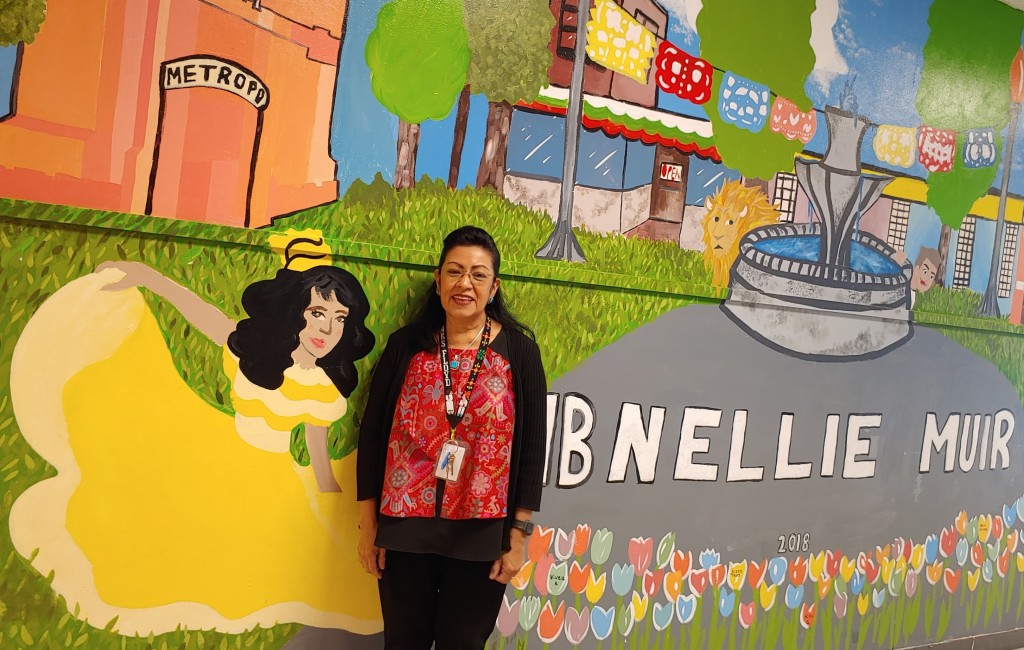
On a sunny day in October, between parent-teacher conferences, kindergarten teacher Rosa Floyd, Oregon's 2023 Teacher of the Year, sits down for an interview in her classroom. Nellie Muir Elementary School in multilingual Woodburn School District is a dual language immersion school of about 414 students, both English and Spanish speaking. Her classroom is full of vibrant colors, little tables and chairs, the alphabet in pretty pictures, and books, posters, and first words in Spanish. For her 20 students, of which nine are English speakers and 11 Spanish-speaking only or bilingual, this is where it all begins. It feels very welcoming.
"The children teach each other," she says. "They acquire the language very quickly at this young age. This is their first experience, so you open a lot of channels for the future. It is an honor to work with these students and families, and it is a big responsibility, transforming lives. When they learn a second language, they learn to see the world in a different way."
School principal Oscar Belanger strides into the classroom with great energy. He has just arrived at school on his motorcycle. "Hola," he says with a warm smile, posing for a photo, then giving her a big hug. "I'm very glad I nominated her," he says. "We couldn't be more proud. When we celebrate, we celebrate as a team, and also celebrate the individual's excellence. Our success is because we are a family." School secretary Leticia Acuna and custodian Juan Cardenas, who both attended Nellie Muir as students, and school psychologist Shannon Brooks, who has worked at the school for 10 years agree. "She is well-deserving of this award… She is amazing… I'm thrilled for her," they say with enthusiasm.

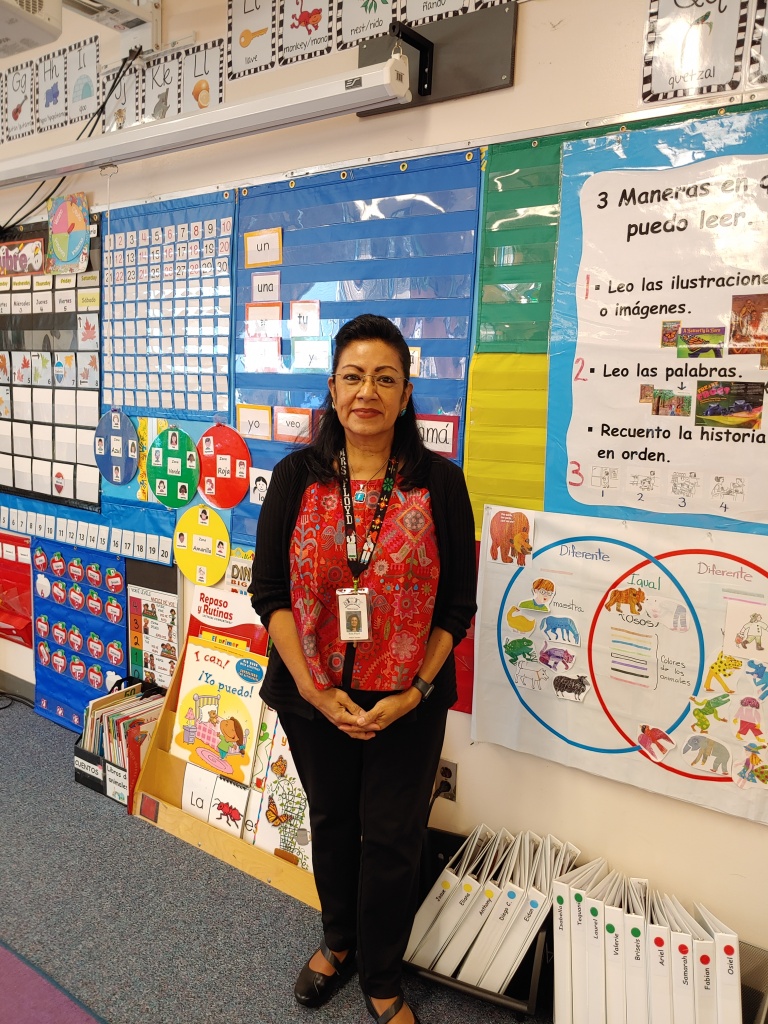
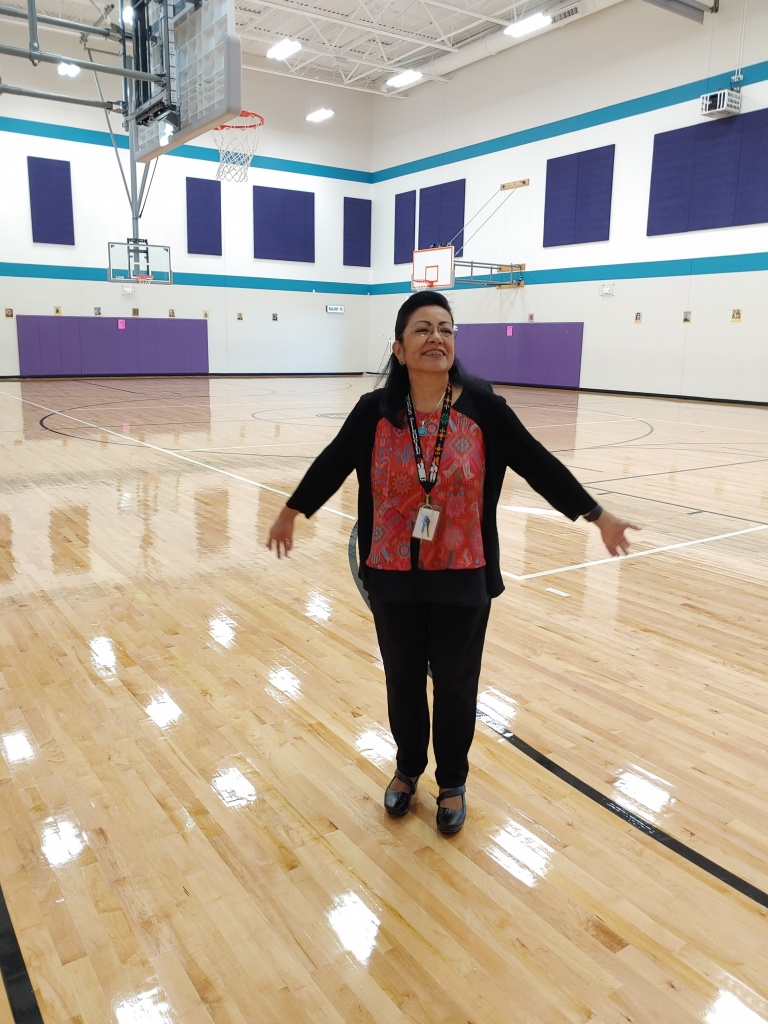
Portland State University: What were your first thoughts after being named Oregon Teacher of the Year?
Rosa Floyd: "The superintendent called for all of us to come to an assembly at the high school. Only five people knew about what was going to happen. Even my husband Sherman, who is also a teacher, kept it a secret. I had no idea I would be getting the award. My first thought when I heard was, this award belongs to all of these teachers."
PSU: How important is it for there to be more dual language teachers in Oregon?
Rosa Floyd: "A lot of my kids have never been to Mexico. They don't have experience of their culture. I want them to be proud of their roots and know they can work to make society better. Education is freedom – freedom to choose what they want to do in life. They are part of the country, they are smart, bright, intelligent, and strong. I want people to appreciate them. They work hard. Having a second language is important, and having a Spanish-speaking teacher lets parents experience stability and trust during times of deep changes, supporting each other to serve the community."
PSU: What should PSU and other Oregon colleges do to encourage more Spanish speaking students to pursue careers in education?
Rosa Floyd: "One big thing is we have to engage them in high school. Many are going to be first generation college students and there is a lack of information. The counselors don't have enough time and resources for everybody. We need to create opportunities and involve parents. You see military recruiting in high school. Go and look for them before they leave. Once they are out, it's too late. Many end up giving up and feel defeated before they start. They need information about programs. Let them know they are welcome.
How did you decide to become a teacher?
Rosa Floyd: "I went through everything my students are going through, coming to this country and adjusting to living in another culture and language. I met my husband at the University of Guadalajara when he was an exchange student. I was getting my master's degree from the School of Architecture in interior design. We married and my family, still today living in Mexico, supported the idea of me coming with him. I first started working as an assistant in a summer program in Hillsboro while he was teaching at Glencoe High School. There were not many Spanish speaking teachers 31 years ago. When I worked with the little students, I decided to rethink what I will do in this country. I began teaching kindergarten at an international school, and then at Nellie Muir, on an emergency license.
PSU: What was your experience in the Bilingual Teacher Pathway program at Portland State's College of Education?
Rosa Floyd: "You have three years to get your license when teaching on an emergency license, and the Bilingual Teacher Pathway program is designed for teachers who are working. I was working full-time, had my five-year-old son, and was expecting my daughter at the time. My husband's mother is also a teacher, and she said, 'We are here for you.' This award is for the whole family.
"The flexibility of the Bilingual Teacher Pathway program, and having Spanish-speaking professors at PSU was a big connection. My professor Julie Esparza Brown was interested in every person, her doors were open all the time. From her, I learned to think one student at a time and not generalize. She makes you feel important. I learned to have an open mind and to see how each person contributes using their own abilities. They also encouraged continued growth through professional development."
PSU: What is the most rewarding part of your work?
Rosa Floyd: "First, it is seeing my kids' faces when they discover they can read or write or use the new language to communicate with others. Also, creating an environment for our kids is why the folkloric dance is one of my big projects. I have been teaching dance because it touches so many people. There are 75 kids that I volunteer to teach as a free after-school activity for students, as well as parents, teachers and administrators."
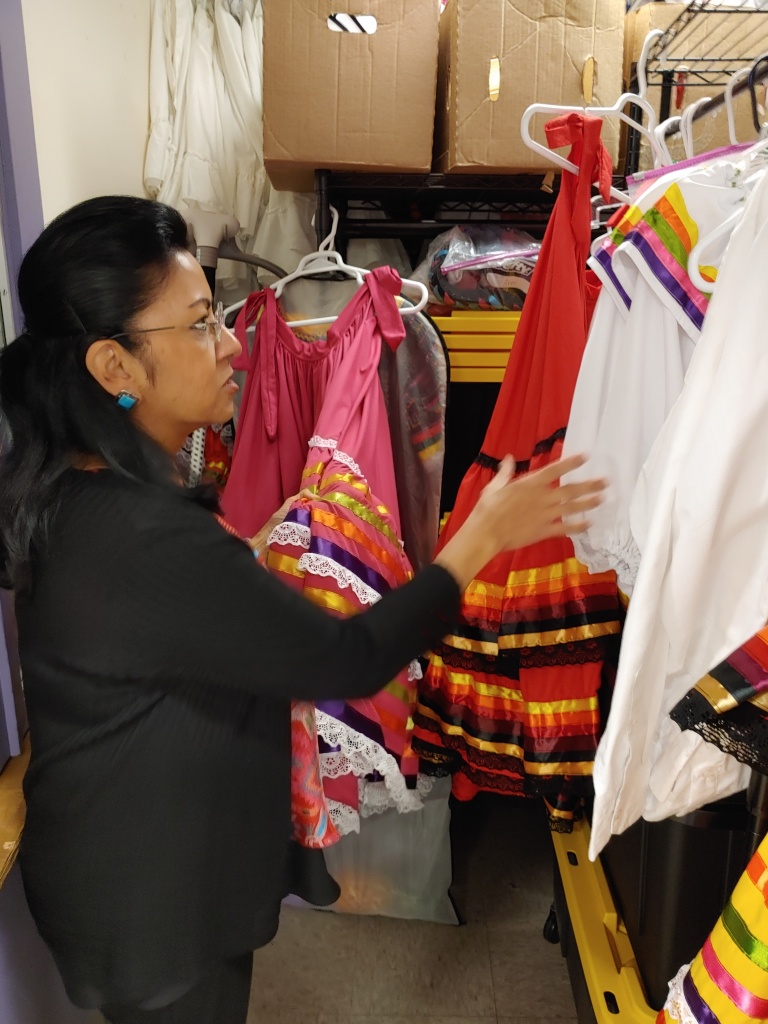
Walking to the gym, she opens a closet full of flamenco dresses and hand-embroidered shirts of all sizes, for children and adults. She sews these costumes herself, ordering fabric and trimmings from Mexico, and says she and the parents have embroidered the blouses together. Each piece of ribbon and lace has a bit of history to it. This evening, after a day at the school, she will lead a rehearsal followed by a performance in Portland of her students from grades three through twelve.
Rosa Floyd: "The students walk here [to Nellie Muir Elementary] from the middle school and high school for the class every Friday. Education is like a dance that helped me to connect with my community. It involves adaptations, tradition, culture, community and partnership. Every human has the ability to learn, grow, develop and create."
The Oregon Teacher of the Year Award was presented to Rosa Floyd on October 4 by Woodburn Superintendent Joe Morelock, Director of the Oregon Department of Education Colt Gill and Governor Kate Brown. As Oregon Teacher of the Year, Mrs. Floyd will be a representative and spokesperson for all Oregon teachers and will travel to Washington, D.C., in March to meet the President of the United States.
###
by Sherron Lumley
Source: https://psucollegeofed.wordpress.com/
0 Response to "Psu Educational Leadership Continuing Administrator Program"
Postar um comentário